Sunday, July 7, 2013

Profiles at Under Armour--Kristyn Daly

Interning at Under Armour the past month and a half has been a blast, and I’m learning so much. In my first week I was assigned two different projects—a vendor scorecard and vendor profiles. Ultimately I was taken off the vendor scorecard project, as it was later known that a group in the home office was already working on scorecards. This left me with vendor profiles, which I’ve recently completed.
The original vendor profile that was bland and boring to look at.
I first made a template for the profile because the existing one was not aesthetically pleasing and I was told to make it fun and interactive. I added different graphs to spice things up. I had to create profiles for each vendor the Hong Kong office is responsible for. The profiles are basically a snapshot of the vendor and includes its on time delivery, business plan, work in process, construction groups it produce for Under Armour, quality, etc. My boss thinks I "hit the ball out of the park" on this project, so I'm really glad that the team likes it. The positive feedback is always rewarding. The pictures are mainly to show the difference between the layout.
This is the layout of the new profile that I created.

An Under Armour poster in Regina Miracle.
Pictures were only allowed in the lobby.
I also had the opportunity to visit a factory, Regina Miracle, two weeks ago in Mainland China where it manufactures sports bras and the newest shoe addition, the Speedform. The Speedform has a seamless heel-cup, and the manufacturing process cuts out close to 30 steps. Because the process is so innovative, it is top secret and we were unable to see production of the shoe. During our tour, however, I was able to see the production of a sports bra from start to finish. Each bra goes through about 40 steps before it’s complete.

Now that my vendor profiles are complete, I’m helping a committee in the office plan Armour Day. Armour Day is basically a day to celebrate the brand. Because the launch of Under Armour in Hong Kong coincides with Armour Day, it’s turned into Armour Week. I’m helping coordinate VIP lists for two football (soccer) games with the Tottenham Hotspurs. During Armour Week, the office will be participating in multiple events, such as the football games, movies and other events. I’m excited for the launch of Under Armour in Hong Kong, but I wish it didn’t happen five days after I leave. It would have been amazing to experience.


Kristyn Daly

Under Armour

The Global Middleman--Melani Cullen


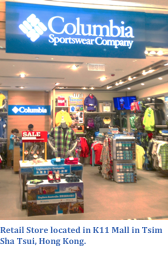
Columbia Sportswear Company (CSC) is an international outdoor apparel, footwear, accessory, and equipment company, whose headquarters is located in Portland, Oregon (PDX). It operates in the United States, Latin America, Asia Pacific, Europe, Middle East, Africa, and Canada. Additionally, Columbia distributes to more than 72 countries, and 13,000 retailers around the world, and it has a very strong online presence, and customers can access the products through the world of e-commerce. Due to the large audience base the company has successfully reached over the years, it uses the third party distributor, Swire, and the international sales team at the company to help sell the products in the Asian market.

Swire is a distributor that was established in Hong Kong, and it manages the Columbia stores in Asia, which are not owned by CSC. You wouldn't be able to tell that CSC does not run those retail stores because Swire upholds to CSC’s brand image. The consistency exhibited location to location is very critical because Columbia is a well-known brand, and consistency around the world eliminates alienation to the loyal customers.

Moreover, not every one is going to like the same cut, style, and color around the world, and not every country is going to need the same outdoor gear--this is where the international sales team at CSC comes in. Essentially, the team is the middleman that bridges the customers and the global market. At the Hong Kong office, this team focuses on the Asian markets. They coordinate with Swire, and they find out what the people need. They tailor those needs to the Asian market, and the people at headquarters allow flexibility, and adjustments made to the original designs as long as they aren’t straying too far away from Columbia’s image. Often, garment colors are changed from a conservative color from the American design, to a bright neon color for the Asian market. Additionally, the international sales team alters the “standardized” sizes since the Asian market generally needs smaller sizing adjustments. It is a back and forth process between PDX, the international sales team, and Swire until everyone is in agreement, and even though CSC doesn’t own the stores in Asia, Swire still needs to have PDX’s approval since it is its original designs.

Melani Cullen
Columbia Sportswear 

Monday, July 1, 2013

“GUESS What?” --Milena Ho

Interning with GUESS Asia Ltd. has been an amazing experience so far.  When we went to look for our offices a few days before our first day of work, the very first thing I saw was the GUESS logo on the wall behind the receptionist’s desk.  The bold, triangle encasing GUESS logo, it looked so official and professional that it gave me a kick of excitement. It reminded me a bit of the scene in "The Devil Wears Prada” when Anne Hathaway enters the Runway magazine’s reception area. It is the corporate fashion world. It is real and the large concrete logo symbolizes it perfectly.

The receptionist's desk with the official GUESS logo displayed behind. 


I am interning for the International Sales and Merchandising Department. I feel so lucky to be part of such a wonderful team because they are so friendly and resourceful!

During my first week, I researched retail markets in southeast Asia. My department works with Singapore, Thailand, Vietnam, Indonesia, Malaysia, India, Guam, and Mongolia. Although it was a lot of typing various phrases into numerous search bars, reading, and taking notes, I learned a lot. The goal behind this task was to find new information about Q1 2013 in these specific retail markets, so that the company was informed about each country’s market and the reasons for why it may or may not be doing well.  I learned that there are several factors that affect the retail market, including social classes, disposable income, economy, housing rates, and rental store space rates. 

This past week, I put together my first “Product Knowledge” booklet for the July collection. This booklet features select garments that are about to arrive in stores and discuss ways to style them. There are also a couple images of similar garments and celebrities rocking those various styles. The “Product Knowledge” booklet aids the sales associates in recommending certain pieces to their customers, depending on which garments he or she is interested in. This meant spending hours and hours sitting at the computer, but it was fun to put together. It almost felt like writing an article for InStyle magazine. I can’t wait to see what the coming weeks will bring!

Part of the GUESS office!

Milena Ho
Guess

Sunday, June 30, 2013

Learning Crocs' Company Culture--Shirley Cheung

My very own desk cubicle and a Dell Laptop for me to use!
I was given my own cubicle with a desk and 3 drawers and a laptop to use. Also provided were basics for me to borrow like stapler, tape, ruler and pens and pencils. They also provided me with a notebook and folders that I could have. As part of endorsing the Crocs culture, I was also given a coupon for a free pair of Crocs shoes that I was to wear to work daily.  Another task they created was to have all their employees work two shifts a year at a company-owned retail store so that the employees could understand the Crocs customer.

First things to get accustomed to when working in a corporate office are abbreviations of words; like GSM, MDS and also abbreviations of the country names are important to a company like mine that takes care of consolidating companies in different countries. Then you should get familiar with their use of vocabulary. In America, what we would call an ‘orientation’ to introduce and teach new concepts to a newcomer, in Crocs, they like to call ‘briefing.’ I have never heard of this term before and did not have the confidence to ask what it was and instead participated in all these “briefings” until I had a slight idea of the term and ended up Google searching the definition online.

The Retail Marketing section of the company floor, the Crocs' office is consisted of
many sectioned cubicles. The "front desk" is actually the first 3 desks by the front
door in the office and the HR region is in the upper right corner section.
It is uncommon to use the term “foresee,” which is frequently used by my company to refer to measuring consumer experience satisfaction, I assumed the term would stand for an act of foreshadowing what customers would want in the future.  Crocs refers to its Foresee manager as the one who deals with consumer experience and satisfaction. 

When I was asked whether or not I knew this term, I said exactly what I thought it meant through observation of how others used it. My team leader did not hesitate in pointing out my mistake in front of the whole group at the meeting and I became the laughing stock. Hong Kong people are known to be very open with their thoughts. But they usually don’t mean any harm, they probably wouldn’t even notice that they may have upset you. The next day this same lady asked me about where I usually eat and introduced me to a favorite place of the employees.


Shirley Cheung
Crocs

Sunday, June 23, 2013

More than just work, more than just the office--Abby Wongsuwan

Interning at VF Asia Ltd. has been one of the most amazing experiences for me. I’ve not only learned about the works in the fashion industry, but I’ve also learned about the corporate culture and the office environment. It’s important to know how to interact with people in the working environment appropriately. The way people act in “The Real World” is very different from how they act in school or in college. Also maintaining a good relationship within and outside the department helps ensure the work to go smoothly. A lot of time these things cannot simply be taught in class. I am very grateful that I got the opportunity to learn this through the real world experience. Surely, these skills will help me pursue my goal in the future professional career.

I learned these people skills by interacting with the people in the office. At VF office, they have pantry area for the staff to eat and enjoy their break. It’s located on every floor. Beside the seating area, the area includes coffee machine, refrigerator, and vending machine. The office provides coffee, tea, water, and other refreshment.  A lot of people also use this area to socialize, talking about work or other topics. Also, the area is used for the meeting when the meeting room is occupied. It provides more of a casual environment for a less serious meeting.
Pantry on the 8th floor.
Since VF is rather a big company, they put together many activities to provide the employees an opportunity to get to know each other both in and outside the department. Coming up is the Ice Cream Day, which will be Friday, June 28 in the afternoon. It will be at the pantry on the 8th floor; I work on the same floor. VF once held friends and family day on the weekend. From these events, photos were collected and shown on the TV monitor on the 8th floor entrance.

Pantry on the 8th floor
One of my favorite events that the company organized was the sample sale. VF has the annual sample sale, that includes every brand, twice a year. Other than that, each brand also has its own sample sale. The brands offer the products to the employees with a very special discount. I went to the annual sample sale, which lasted two days. Almost everyone came to the sale. I recognized all the managers and staff from all different departments, the IT specialist from the help desk center, and the staffs from the mailroom. Surely almost everyone in VF participated in this event and they seemed to enjoy it every much.


Abby Wongsuwan
VF

Nearly Free Samples--Angelina DiFrancesco

During my first week at Ann Taylor in Hong Kong, I received a curious email that immediately caught my attention. "Sample sale this Thursday & Friday! All pieces  $15.00. Preview this Wednesday with damaged and marked samples for only $3.00!" To put that into perspective, 15 Hong Kong dollars is only $1.93 USD and 3 Hong Kong dollars is 39 cents. You can't get much better than that!


Here I am digging through the tops at the sample sale with my associates.
You can see that the whole room is full of tables piled high with garments.
The sample sale is a seasonal event held as a way to unload garment samples and make some money back. Samples are created by the factories and then sent to the office in Hong Kong. The first sample is the line review sample, of which there are three copies. We mark one sample and send it to our counterparts at the New York office for approval and fitting. We keep the other two samples in Hong Kong. One is for the tech team and one is for our local QA, or quality assurance team. Once a sample passes all tests and is approved by New York, we can order in bulk. Sometimes the first fit is approved, but other times New York requests another, called the 2nd fit sample. For more complex garments, a 3rd fit may be necessary.


My associates Kitty, Sindy, and Clara enjoying the sample sale.
They were very helpful and picked out clothes for me to try on.
With all these samples floating around, it is no wonder that Ann Inc. gets stuck with a lot of extra garments. Samples cannot be sold in stores and the sample sale is open to employees only. I walked into what is usually a meeting room, but instead it held large tables piled high with numerous garments. That was when the madness ensued. Everyone was digging through the piles and grabbing whatever they could get their hands on. I had a hard time getting into the fray, so my associates kindly picked garments out for me and gave me feedback on the fit. The garments were marked "SAMPLE," "1st," or "2nd," indicating there place in the development process. Unfortunately for my small-framed associates and I, all of the samples are size 8 or size 8 petite. With the help of a belt and the serendipitous fact that loose fits are in, I was able to pick out an Ann Taylor jacket and a LOFT sweater for only $3.86 USD. Ann encourages us to wear its clothing, but it doesn't have any stores in Asia. Many of my associates have never been to the brick and mortar stores, so the sample sale is an important way for them to experience the brand.


Angelina DiFrancesco
Ann Taylor Sourcing Far East Ltd.


One-Week Factory Visit in Mainland China--Eva Hu

Week 3, the experience working in China was totally different than working in Hong Kong. Instead of sitting in the office, I could finally discover my wonders about what is inside of “Made in China” in person.  As company scheduled I visited 4 factories with my colleagues in P.R.C to understand the production flow.  The factories that I visited manufacture handbags, luggage, fabric and ox hide for Kipling and Eastpak.

When I walked into the first factory mill, Winning Dragon, I was overwhelmed by the work environment. Repeating noisy sound coming out from thousands of sewing machines, hot humid air smelt bad with machine oil and people’s perspirations. I felt like I was going to die in 10 seconds and hope to never work in this kind of environment. However when I turned around and saw those hardworking people, I suddenly raised my sympathy and regret. Some of workers looked similar like my age but we seemed in totally different status. They quitted to pursue higher educations in order to make money and feed families. In contrast, I was there to learn, to understand the production side of knowledge, in order to enhance my career development for my own interest. The supervisor who guided me is from Taiwan, told me he has been staying in Mainland China for 10 years managing the factory. He has seen a huge skill development on Chinese workers from zero to ten. That is becoming a part of reason why some the labor cost in China is increasing, in addition to some regulations from government, now a lot of manufactures are moving out of the country. For instance, Eastpak has moved their factories in Bengal, Cambodia and Thailand to save on cost. But on another aspects, China is moving forward to make better quality goods associate with prestige.

This is my factory mill called Winning Dragon. They produce 85% handbags for Kipling.
During the time spent there, I realized using technology is becoming an important role in Chinese manufacturing. Computerized pattern making machines and camera surveillances are widely used in factory mills. The company installed “water windows” to prevent worker dehydration and this helped cool down the overall temperature in factory mills. The function is similar like using air-conditioning, however, that is more energy and cost friendly.

The factory has improved a lot of technology. It's using computer software to sketch the blueprint of each individual piece.
My last factory visiting to a leather manufacturer was the worst experience I ever had. The harsh environment in that workshop was challenging to my body.  I spent two hours in the factory mill to understand the flow of making animal leathers, which is a procedure to change raw leather into a ready fabric. The stench of animal leather almost made me faint. A lot of chemical products were used on leathers to make unique textures and color effects, which made the smell even worse. While doing the chemical part, I did not see any workers with masks on or other protections. This made me worry about the workers’ safety and health. I cannot image the workers working in those conditions for 8 hours, 5 days a week without AC. Indeed, most of workers looked about 20 years old, but what surprised me were their facial expressions. There was no emotion attached, and ironically, they look like robots.

Harsh environment in the leather factory, workers usually do not have any protection in this factory mill. The smell in the factory was terrible because of the animal skin and chemical products.
After this factory trip in China, I start to realize the importance of the supply chain and sourcing in the overall production flow. I don't want to mention too much about the workers and their personal well being, but I think they deserve to be paid more given the tough working conditions they experience. 


Mengyi Hu (Eva)
VF